

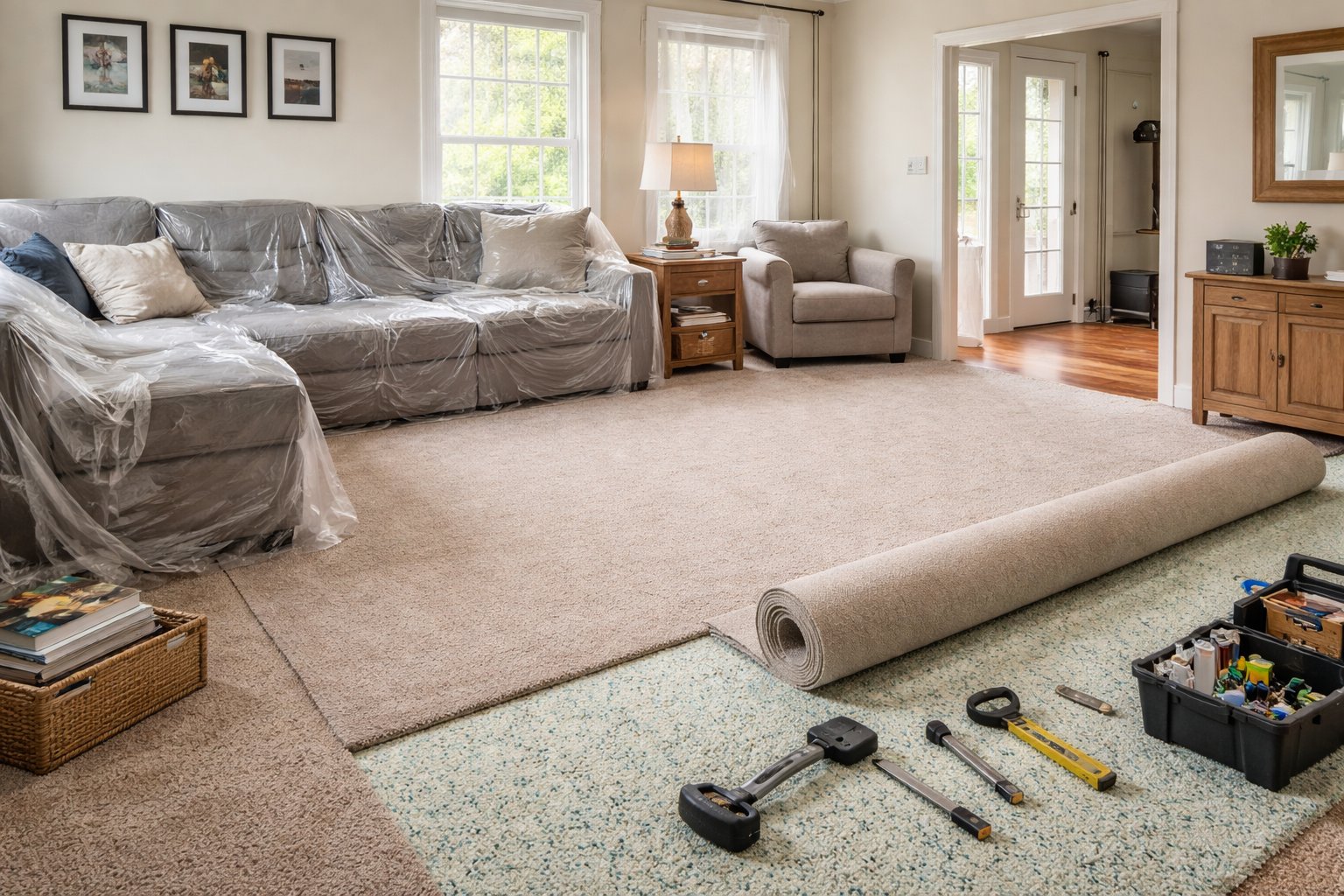
Carpet is one of the most comfort-driven flooring choices in a home, but the feel underfoot and the long-term performance depend just as much on the installation method as the carpet style itself. A premium carpet can still ripple, separate, or show premature wear if the installation approach doesn’t match the space. That’s why understanding the main carpet installation methods still matters—especially now, when open floor plans, heavier furniture, and busier households put more stress on floors than ever.
Among all the modern options, stretch-in continues to be the go-to method for many residential rooms because it balances comfort, stability, and long-term serviceability in a way that adhesive installations often can’t.
The three most common carpet installation methods
Carpet installation generally falls into three categories, each designed for different demands:
Stretch-in (tack strip) installation uses tack strips around the perimeter of the room, a separate cushion (pad) beneath the carpet, and specialized tools to stretch the carpet tight before securing it along the edges.
Direct glue-down installation bonds the carpet directly to the subfloor with adhesive, skipping the traditional pad.
Double glue-down installation glues the pad to the subfloor and then glues the carpet to the pad, creating a more cushioned glued system than direct glue-down.
All three can be done well, but the “best” method depends on the room’s use, traffic patterns, subfloor conditions, and comfort expectations.
Stretch-in installation, broken down simply
Stretch-in works because carpet is meant to behave like a textile surface—flexing slightly with everyday movement, temperature shifts, and furniture changes. With tack strips holding the perimeter and padding supporting the field, the carpet can stay smooth while still feeling soft and forgiving.
A proper stretch-in installation relies on power stretching (not knee-kicking alone) to reduce the risk of ripples and wrinkles later. Seams are positioned thoughtfully, transitions are secured cleanly, and edge tension is consistent across the room. When this method is done right, the surface looks tailored and stays that way longer.
Why stretch-in still wins in most residential rooms
Stretch-in remains a favorite in bedrooms, living rooms, bonus rooms, and many stairs/hallway scenarios for a few key reasons:
Comfort is noticeably better. The pad is not just “extra softness”—it’s a shock absorber that reduces stress on carpet fibers with every step.
It protects the carpet backing. The cushion reduces the impact forces that slowly break down backing and fiber twist, especially in higher-traffic paths.
It handles seasonal movement. Homes expand and contract subtly through the year, and stretch-in systems tend to tolerate those micro-changes without telegraphing issues on the surface.
It’s easier to service later. If a future repair, partial replacement, or deep cleaning is needed, stretch-in is typically easier to work with because the carpet isn’t permanently bonded to the subfloor.
For anyone browsing carpet flooring options with comfort and longevity in mind, stretch-in is often the method that delivers the most “lived-in” success over time.
Where glue-down makes sense (and where it doesn’t)
Glue-down installations aren’t “bad”—they’re just more situational.
Direct glue-down is common in commercial environments where rolling loads (office chairs, carts) and constant traffic demand a very stable, low-profile surface. In residential spaces, it can feel firmer, transmit more sound, and make future changes more labor-intensive.
Double glue-down can be useful in specific scenarios where extra dimensional stability is needed but some cushioning is still desired. It’s often seen in certain commercial or mixed-use spaces rather than typical bedrooms and family rooms.
A key point: glue-down performance is heavily dependent on adhesive selection, subfloor preparation, humidity control, and correct trowel technique. When anything in that chain is off, problems like bubbles, loose edges, or adhesive bleed-through can show up.
Padding: the quiet decision that changes everything
Padding is the hidden layer that influences comfort, insulation, sound, and carpet life. Too soft can cause excess flexing (leading to faster wear). Too firm can reduce comfort and make the carpet feel harsher than expected.
In stretch-in systems, the right pad supports the carpet while helping it keep its shape. It also improves the “return” feeling underfoot, which is one reason stretch-in remains the most satisfying choice in lounging spaces.
Common stretch-in myths that still float around
“Stretch-in is outdated.” Not true. Power-stretching tools and modern tack strip systems are designed for today’s carpet backings and room sizes.
“Glue-down lasts longer.” Longevity depends more on correct installation, correct product pairing, and correct subfloor prep than on adhesive alone. A properly stretched carpet over a quality pad can outlast a poorly executed glue-down every time.
“Wrinkles mean stretch-in is unreliable.” Wrinkles usually point to under-stretching, weak perimeter hold, inadequate seaming, or improper acclimation—not the method itself.
Choosing the right method for each space
In many homes, stretch-in is the best fit for comfort-forward rooms, while glue-down can be considered for special-use areas that demand added stability. Subfloor conditions, room shape, transitions, and traffic patterns should guide the decision—not trends or assumptions.
Working with experienced installers matters here because details like seam placement, moisture conditions, and door/transition planning often decide whether a carpet looks great for years or starts showing issues early.
Quick wrap-up: why stretch-in still matters
Stretch-in remains relevant because it matches what most households actually want from carpet: softness, resilience, clean appearance, and the ability to service or update the floor later without a demolition-level teardown. Modern methods have their place, but stretch-in continues to be the residential standard for good reason.
Talk with a flooring expert in Sandy Springs today!
To plan the right installation approach for the space, get started by booking through the contact page and then connect with Great American Floors or call (404) 476-5184—family owned and operated since 1992 and proudly serving Sandy Springs, Atlanta, Roswell, Dunwoody, Norcross, Marietta, and Alpharetta.


