

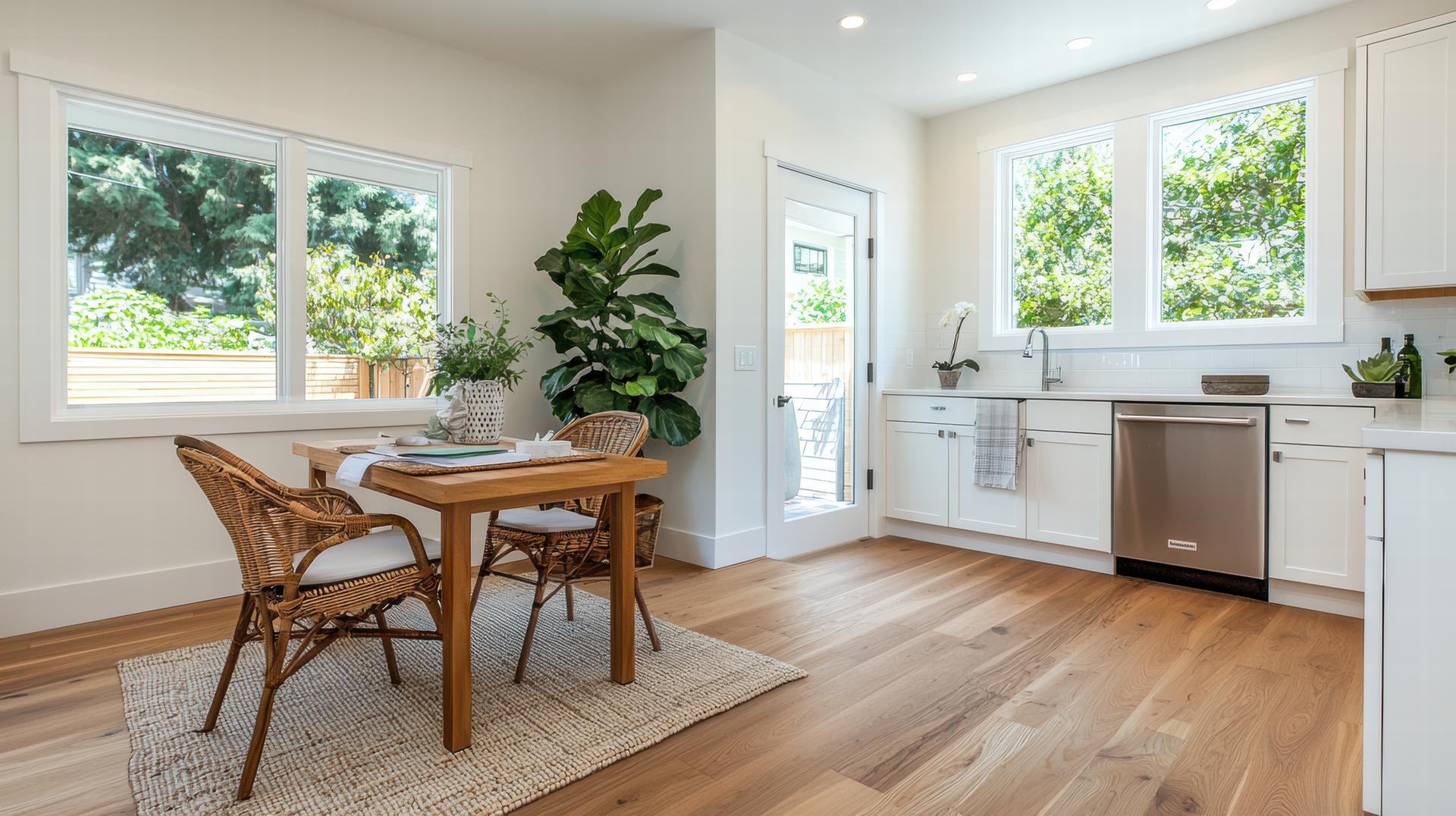
There is a moment every homeowner knows well. You are standing in your kitchen or looking down at your basement floor, and you think: "I want hardwood in here." Then someone tells you that hardwood and moisture do not mix, or the quote comes back and the number makes you sit down for a minute. And just like that, the dream hits a wall.
Here is what most people do not know: you do not have to give up the look. Laminate flooring has come a very long way from the flat, plasticky floors of the 1990s. Today's laminate can replicate the grain, texture, and visual warmth of real hardwood so convincingly that guests genuinely cannot tell the difference. And in spaces like kitchens and basements, where solid hardwood simply is not the right tool for the job, laminate steps in and does the work beautifully.
Why solid hardwood struggles below grade and near water
Let's give hardwood its due first. Real hardwood flooring is a timeless material. It adds genuine character and lasting value to a home, and in the right rooms, it is hard to beat. But wood is organic, and organic materials respond to moisture. That is not a flaw; it is just chemistry.
In kitchens, you have steam from cooking, splashes at the sink, the occasional dropped glass of water, and humidity that fluctuates with the seasons. In basements, you are dealing with concrete subfloors, below-grade moisture that wicks up from the ground, and temperature swings that make wood expand and contract in ways that lead to warping, gapping, and cupping over time.
Installing solid hardwood below grade is a risk most flooring experts would advise against. And even in kitchens, where it can work, it requires very careful maintenance and a high tolerance for the fact that the floor will show its age faster than anywhere else in the house.
What modern laminate actually looks like
This is the part that surprises most Atlanta-area homeowners who have not looked at laminate recently. The technology has genuinely changed.
Modern laminate is built in layers. The core is a dense fiberboard that resists impact and provides stability. Above it sits a photographic layer, which is a high-resolution image of real wood grain, captured from actual wood species. Over that is a wear layer, a tough clear coating that protects the image from scratches, scuffs, and daily foot traffic.
The result is a floor that looks like wood, feels textured like wood thanks to embossed surface finishes, and in many cases comes with an AC (Abrasion Class) rating that tells you exactly how much traffic it can handle. A good AC4 or AC5 rated laminate will stand up to a busy kitchen with kids and pets without flinching.
The moisture question: where waterproof laminate changes everything
The older knock on laminate was always moisture. Early laminate did not handle water well at all. The fiberboard core would swell if water got into the seams, and once that happened, the floor was finished.
That problem has been largely solved. Many of today's laminate products feature waterproof cores and tight-locking click systems designed to keep moisture out at the seams. Some are tested for full wet-area performance. If you are installing in a kitchen or a finished basement in Dunwoody or Roswell, pairing laminate with a waterproof flooring core gives you the hardwood aesthetic without the vulnerability.
That said, no flooring is truly invincible. Standing water left for extended periods can still cause problems in any product, and proper subfloor preparation in a basement, including moisture barriers, is essential before any floor goes down.
The honest side-by-side
Here is where things land when you compare them directly for kitchens and basements:
Hardwood gives you authenticity, refinishability, and long-term value. It can be sanded and refinished multiple times over decades, which is something laminate cannot offer. If your kitchen has lower moisture exposure and you are committed to the upkeep, hardwood remains a valid choice in that space.
Laminate gives you the visual result you are after at a friendlier price point, with far better resistance to the conditions these rooms actually create. It installs faster, requires less maintenance, and in a basement, it is the significantly safer long-term choice.
For most homeowners asking "how do I get hardwood floors in my kitchen or basement without the risk," the answer is a quality laminate with a waterproof core. You get the look. You avoid the headaches.
Great American Floors: helping Sandy Springs homes get it right since 1992
At Great American Floors, our flooring experts help homeowners across Sandy Springs, Buckhead, Brookhaven, East Cobb, Dunwoody, Roswell, and Alpharetta make confident decisions for every room in their home, including the tricky ones. We will show you laminate options that genuinely fool the eye, walk you through what each product can handle, and make sure you are not putting the wrong floor in the wrong space. Schedule your free in-home estimate and we will bring the samples to you.


